Let me start by posing a question to you.
When you hear the word "consumption", what comes to mind? Is it food? Clothes? Or maybe the shows you binge-watch or the videos you scroll through at midnight? Most of us picture a shopping bag or a plate of food. I did too. If you had asked me a few weeks ago whether I was a "consumer", I probably would have shrugged and said I just buy what I need. These meanings of consumption aren’t inherently wrong; in fact, they are all forms of consumption. However, consumption becomes far more complex and nuanced when we consider the reasons we consume or the role it plays in our society. If you were to track an ordinary day, you'd find that consumption is unavoidable.
So what does "consumption" actually mean?
The word carries far more meanings than I expected. At its simplest, it is using something up: eating, drinking, spending. To “consume”. But in Module 2, consumption became cultural. De Solier (2013) explains that in post-industrial society, we increasingly form ourselves not by producing things but by consuming them, especially through our taste for certain kinds of things, which carry "sign-values" that others can read (de Solier, 2013, pp. 110-111). What I wear, eat, watch, and post says something about who I am, or whom I want to be.
Consumption is also driven by morals. De Solier (2013, p. 115) uses the “foodie” example, in which an individual who loves every cuisine is considered a "moral self" because their appetite is seen as open-minded rather than elitist. This idea aligns with what is usually called ethical consumption, such as buying fair trade, shopping second-hand, and avoiding fast fashion (Arman & Mark-Herbert, 2024, p. 1). Even our choices about what to buy are treated as a measure of our character. With this realisation, I start to feel perturbed, as it suggests that consumption is something to be judged, rather than a mindless act.
Ethical consumption then has its catch. If morality can be bought, then being "good" becomes another thing to purchase, and people with more money can afford to look more ethical (Littler, 2010, p. 70). I have caught myself choosing a product because it looked sustainable, or said it was, without checking whether that was true or not. This itself is a whole separate argument on companies' “greenwashing” (Littler, 2010, p. 64), but the message is that even our attempts to consume responsibly are shaped by marketing, price and the signals we want to send about ourselves.
That raises the question of whether we even see ourselves as consumers. Many of us resist the label because it sounds shallow or materialistic (de Solier, 2013, p. 108). But the problem society is facing is that we have no choice. We cannot survive without consuming. Food, water, shelter, electricity, education, culture, transport and medicine are all consumed.
Timothy (2005, p. 15) notes that, throughout most of recent history, shopping was viewed as a strenuous activity undertaken as a means of survival. So, consumption is two things at once: a necessity that cannot be opted out of and a cultural performance to express identity. The interesting question is not whether I consume, but how, why, and who is shaping the way I do it.
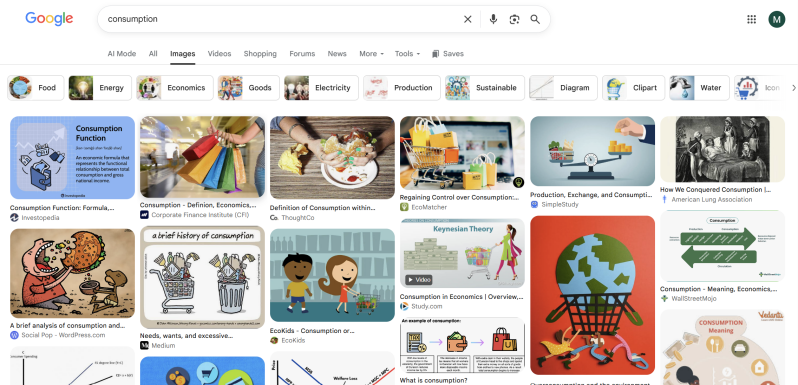
An ordinary day, itemised
Today began with an hour of scrolling through my social media in bed, realising I need fuel to get to campus, then filling up my car, paying for parking, and buying a coffee from a café on my way to class. After, I chose where to eat by scanning Google reviews, found a Japanese restaurant and bought lunch from there. That night, I streamed a series on Netflix while scrolling on Depop for things I did not need. None of this felt like "consuming". It felt like routine living. Consumption is not an activity that can be switched on and off, only the medium through which my day is lived.
Were my decisions influenced by certain aspects, cultures, or morals?
Of course!
Whether we believe so or not, every decision ever made has been influenced by something or someone else.
OR even for something or someone else…
I would have told you my love of Japanese cuisine came from my own curiosity, but de Solier (2013) complicates that. Many of her informants acquired their sophisticated taste in food through food media rather than their families or schooling (de Solier, 2013, p. 137). Khorana (2018, p. 97) adds that shows like MasterChef Australia make diverse, upmarket food seem "attainable", producing the "everyday foodie", who loves gourmet food culture but feels limited by time, money or confidence. Noble and Ang (2018) also show that knowledge, taste, and participation vary between and within ethnic groups and across generations in Australia, so my taste reflects both my family background, my surroundings, and what I watch.
I will admit, over the last three months, my spending habits have changed drastically. Just coming back from a six-week holiday, which was carefully planned and budgeted for, has completely changed the way I consume.
Before: Travelling, and spending without thinking
The clearest way I can see and further understand my consumption is by comparing two versions of myself. The first was travelling through Europe and Africa. On that trip, I was more than happy to buy anything I desired, as I had done the hard work of saving all year to achieve financial freedom. Buying souvenirs, clothing, coffee and local cuisine guilt-free.
In a way, my consumption was used to save a moment that wouldn't last forever. My consumption was making memories.
Pine and Gilmore (2011) describe this well by arguing that businesses now stage memorable experiences so that the memory itself becomes the product. I was not only paying for a coffee but paying for the feeling of sitting in a European square with it.
My photos and souvenirs tell a similar story. Lee (2012) shows that tourists often travel to places they already know from films and books, so a site becomes a layered mix of real history and fiction, and visitors consume the story as much as the place. I did the same with the Sahara Desert in Morocco, coming home with a magnet, postcard, and scarf, and those objects now do much of my remembering for me.
Timothy (2005, p. 36) also reports that people tend to enjoy shopping more when they have more financial resources, while limited funds reduce enjoyment. I enjoyed spending in Europe partly because the money felt unlimited.
After: broke, buying only necessities
Then the trip ended, and so did the money. Now, the way I consume has changed completely. Every purchase is now purposeful. I buy groceries, transport, fuel, the occasional bill, and almost nothing else. Where I once bought whatever I desired, I now stand in the aisle and ask whether I need something or merely want it. Timothy (2005, p. 160) calls routine purchases of essentials "quartermastering", usually boring and laborious, and that is now nearly everything I do. Timothy (2005, p. 23) separates "buying", obtaining a specific item, from "shopping", which also involves browsing and comparing.
I have moved from shopping to buying.
This shift made me notice things I had previously missed. At the shopping centre, I can now feel the manipulative design working on me. It becomes so easy for a shopper with a specific purchase in mind to become an impulse shopper, feeling their walk shift from purposeful to wandering (Wrigley & Lowe, 2002, p. 177).
Being short of money makes me hyperaware of this.
But this has also forced me to question the word "necessities". Who decides what I need? I defend my phone plan, my coffee and my streaming subscription as essentials, yet they are cultural expectations as much as physical ones. And my frugality is temporary and specific. I know that I will eventually earn and spend again, whereas for many people, limited spending is permanent. de Solier (2013, p. 113) reminds us that food and taste have long been used as a means of class distinction. Being "broke" has taught me that consumer culture is not equally open to everyone. The things I now skip, such as eating out, new clothes and weekend trips, are exactly the things that signal belonging to a certain lifestyle, and going without them can feel quietly isolating when friends are still spending.
Even my degree has a price tag
The most interesting findings of my day-to-day consumption were my education. Consumer studies note earlier research suggesting that students who see themselves as consumers focus on "having a degree and not being a learner" (Gupta et al., 2023). Their focus groups across Denmark, England and Spain found that most students resisted the label, insisting education is a right rather than a product to be consumed.
Now that I am seeing the role of consumption in my day-to-day existence, reflecting on education as a “thing” to consume was not how I would have described it. I pay fees so I expect value.
Briggs (2013) helps explain why. Consumers, unlike "recipients", are given offers and options, which puts the responsibility on the institution to satisfy me rather than on me to connect with what it offers. Gupta et al. (2023) also found that students hold several views on consumerism at once, and that is true for me. I am a customer and a learner at the same time.
My understanding
Before this module, I thought of consumption as a series of personal choices. The readings did not make me feel guilty, but they changed the question. Rather than asking "what do I like?", I now ask "who taught me to like it, who benefits, and how am I being addressed?" Media taught me my taste, platforms turn my participation into labour, and even tourism and education are sold back to me as products.
Of course, I will still spend again once I am earning. We cannot stop consuming, and I do not think we are meant to. It's our way of self-expression, learning, and the key to evolving. But I can now notice the moment I am being positioned as a consumer, and that gap between noticing and acting is important.
So, I will leave you with the question I started with…
What comes to mind when you hear the word "consumption"?
Create Your Own Website With Webador